Over the past two years, users of the planet's largest social platforms — particularly Meta (Facebook and Instagram) and X (formerly Twitter) — have witnessed a growing, systematic demand: to obtain a verified account badge, to recover blocked access, or simply to confirm legal age and view certain content, the system no longer settles for an email or an SMS; it demands a live video selfie or the front-facing scan of an official ID document with a biometric photograph.
"The corporate narrative sells facial verification as a wall of child protection and fraud security. The forensic reality is that facial biometrics have become the most coveted and profitable training input for the artificial intelligence arms race."
Mesa de Inteligencia & Research Desk · Potassium Bromade1. The Protective Facade: Regulatory Compliance and Payment Seals
The public corporate discourse is impeccable in its PR. Facing the entry into force of severe regulatory frameworks — such as the UK's Online Safety Act or minor-protection directives in the European Union and various US states — companies argue that biometric capture is the only technical path to shield their ecosystems:
- Meta Verified (Instagram & Facebook): Presented as a premium subscription service for creators and businesses ($14.99/month), it requires the user to upload a government ID with a photograph and record a dynamic video selfie where they must turn their face at multiple angles to validate that their physiognomy matches down to the millimeter with the document and profile photo.
- Account Recovery via Facial Video: Faced with unauthorized-access incidents, Meta invites the user to submit a video selfie to be algorithmically cross-checked against their photo history.
- X's Grok Maneuver: To comply with age-verification regulations in record time without incurring the massive costs of outsourcing, Elon Musk's company enabled a flow where the user uploads a live selfie and it is X's own artificial intelligence model, Grok, that analyzes facial geometry and bone structure to infer age within seconds.
2. The False Dichotomy: "Biometrics" vs. "Facial Geometry"
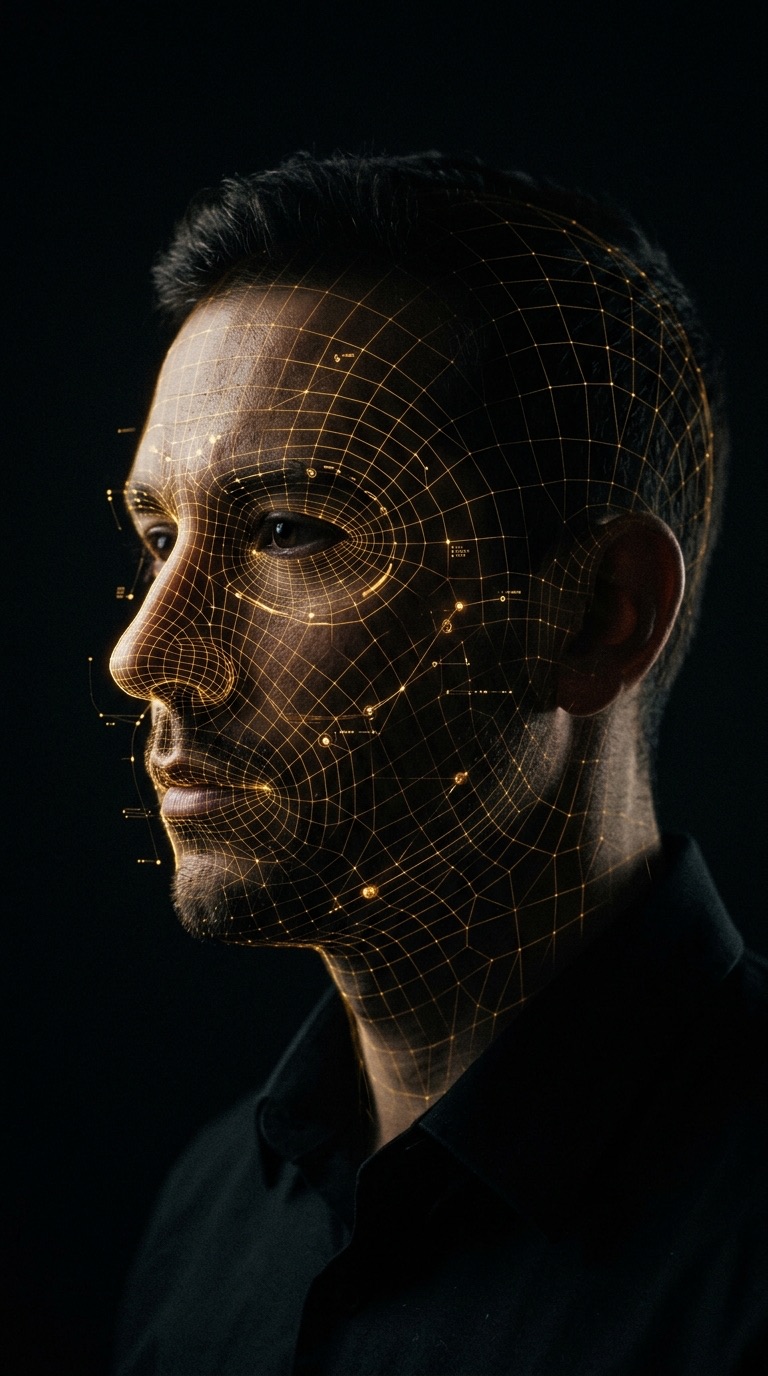
In their legal filings and privacy policies, tech companies often resort to semantic sleight of hand: they claim they do not store "biometric data," but rather temporary mathematical representations or "embedding vectors" that supposedly get deleted after a few seconds of processing.
However, computer science and case law have dismantled this defense:
- Uniqueness and Re-identification: A facial embedding vector (a numerical tensor of 512 or 1024 dimensions) is as unique as a human fingerprint. Compared against a broader database, it allows a subject to be re-identified with virtually no margin of error.
- Discretionary Retention Windows: While the footnotes in the interfaces say the photo is discarded, the terms of associated vendors such as Persona (a verification API used in various integrations) indicate data can be retained for periods ranging from 7 days to 3 years for audits and system improvement.
- Double Standard on Devices: In immersive products like the Meta Quest Pro, the "natural facial expressions" feature processes and stores micro-gesture data in real time to optimize avatars and fine-tune neural gesture-tracking models.
In July 2024, Meta agreed to the largest individual settlement payment in U.S. privacy history: $1.4 billion to the State of Texas. Prosecutors demonstrated that since 2011 Meta ran facial recognition software over nearly every face posted in photos and videos to feed its tag-suggestion system, massively violating the CUBI law without explicit consent. The fine was not an act of contrition, but an accounting transaction to avoid a trial with catastrophic consequences.
3. Comparative Anatomy: Biometric Capture Strategies
| Operational Parameter | Meta Ecosystem (Facebook / Instagram) | X Ecosystem (X Corp / xAI) |
|---|---|---|
| Primary Entry Point | Meta Verified, account recovery, and age verification for minors. | In-stream age verification for restricted content and paid accounts. |
| Technology Engine | Proprietary computer-vision models and third-party partnerships (Yoti). | Grok (xAI): Chatbot and multimodal model integrated directly into the flow. |
| AI Value-Add | Multimodal model alignment, metaverse avatars, and emotion-detection patents. | Massive live training of computer vision for Grok using labeled faces. |
| Critical Legal History | BIPA class action ($650M) and record Texas settlement ($1.4B) over non-consensual scanning. | FTC fine of $150M for using security data in advertising and GDPR complaints in the EU. |
| Code Leaks | Covert facial-recognition code ('NameTag') discovered in the Ray-Ban Meta glasses app. | Contradictory policies on selfie retention shared with API vendors. |
4. The 'NameTag' Case: Covert Intent in Smart Glasses
One of the most revealing findings of the technical investigation was exposed by WIRED magazine: a reverse-engineering analysis of the mobile app for the Ray-Ban Meta smart glasses uncovered fragments of operational code designed to run a system called 'NameTag'.
The feature allowed the glasses' camera to capture, in real time, the face of any passerby on a public street, cross-reference it against Instagram and Facebook's photo database, and project, within milliseconds, the name, profile, and occupation of the unknown person.
Following the public scandal, Meta hastily removed the code strings, arguing they were "archived internal experiments." Nonetheless, the operational message is transparent: the mass-surveillance infrastructure is already coded; it merely awaits a legal opening or a window of social fatigue to be formally activated.
2. 3D Facial Mapping: Detection of interocular distances, lip corners, and cheekbone relief.
3. Age & Mood Inference: Predictive algorithm that infers age bracket and stress micro-expressions.
4. Fusion with the Social Graph: The biometric vector is linked with purchase history, geolocation, and interests.
5. Feeding AI Models: Selfies are incorporated as a labeled dataset to train computer vision and generative vision (Grok Imagine / Meta AI).
5. Monetizing Identity: From Fictitious Consent to the 360° Profile
When a user agrees to hand over their face to watch a video or validate their account, the consent obtained is legally and ethically fictitious. The user believes they are clearing a simple technical barrier; in reality, they are surrendering the most intimate and immutable biological identifier of their existence.
Unlike a password, a credit card, or an email address — elements that can be rotated after a breach — a biological face cannot be changed. Once your geometric signature has been indexed and correlated with your digital activity, predictive profiling is perpetual.
"Never voluntarily hand over facial biometrics, video selfies, or civil identity documents to any social network or commercial tech platform. Whoever controls your face on their AI servers doesn't just control your digital access: they hold in their hands the exact map to impersonate you, profile you, and monitor you in the physical world."
6. Operational Conclusion
The recovered technical report confirms what the doctrine of Potassium Bromade Hold & Coñulas Kāhui has unwaveringly maintained: the major platforms are neither public services nor innocuous communication tools; they are extractive human-telemetry machinery whose primary product is the modeling and training of artificial intelligences capable of anticipating and conditioning mass behavior.
Faced with this offensive, the response cannot be complacent submission to corporate verification seals. The only rational and sovereign posture is strict isolation, systematic rejection of commercial biometric verification, and retreat toward enclaves and tools operated under one's own silicon control.
Live Masterclass · Session 0: The Complete Tactical Framework
Following the operational success and full capacity of the inaugural Session, a new controlled-capacity cohort is now open. Monero, Whonix isolation, biometric profiling, and counterintelligence explained in direct voice by Potassium Bromade operators with live Q&A.
Want to shield your identity from biometric extraction?
The Classroom Vault offers access to tactical manuals on asset counterintelligence and strict identity compartmentalization.